Beyond Hot Flashes: Menopause & Oral Health

By Laura Dougherty, D.D.S.
When women talk about menopause, the conversation usually revolves around hot flashes, night sweats, and sleep struggles. What rarely enters that discussion is oral health. Most people don’t think of their dentist when talking about menopause, but perhaps they should. The hormonal changes that occur during perimenopause and menopause can significantly impact the mouth, gums, and the bone that supports our teeth. These changes are often dismissed as simply part of “getting older,” but understanding them can help women protect both their oral health and their overall health.
Hormones and the mouth
Estrogen plays an important role in maintaining bone density and supporting healthy tissues throughout the body, including the gums and jawbone. As estrogen levels decline during perimenopause and menopause, women may begin to notice subtle changes in their oral health. Some experience increased gum inflammation, a higher risk of periodontal disease, increased tooth sensitivity, or dry mouth due to reduced saliva production. Others report symptoms such as burning mouth syndrome or changes in taste. While these symptoms may seem minor, they can signal larger changes happening within the body. Declining estrogen levels can contribute to bone loss, and that loss does not only occur in the hips or spine. It also affects the alveolar bone, the bone that surrounds and supports the teeth. When bone density in the jaw decreases, teeth can become more mobile and periodontal disease may progress more quickly. Studies published in journals such as the Journal of Periodontology and the Journal of Clinical Periodontology have identified associations between reduced estrogen levels and increased periodontal breakdown. These findings highlight an important reality: oral health is closely connected to hormonal health.
Osteoporosis, bone health, and bisphosphonates
As women transition through menopause, the risk of osteoporosis increases significantly. In fact, more than 53 million Americans over the age of 50 either have osteoporosis or are at high risk of developing it, the majority of them women. To reduce fracture risk and strengthen bones, many physicians prescribe a class of medications known as bisphosphonates. Common examples include Fosamax, Actonel, Boniva, and Reclast. These medications are widely used. In the United States, millions of women take bisphosphonates each year to treat or prevent osteoporosis, with more than five million patients over the age of 55 receiving a prescription for one annually. Bisphosphonates work by slowing the natural breakdown of bone, helping maintain or improve bone density over time. For many women, they play an important role in preventing fractures and maintaining mobility later in life. However, these medications also influence how bone heals and remodels, something that becomes especially relevant in dentistry.
Why your dentist needs to know
Although uncommon, one potential complication associated with long-term bisphosphonate use is a condition called medication-related osteonecrosis of the jaw. This occurs when the jawbone does not heal normally after certain dental procedures, sometimes leading to exposed bone. The overall risk is low, particularly for patients taking oral medications for osteoporosis. However, the risk increases with longer duration of medication use and with procedures that involve the bone, such as tooth extractions, dental implant placement, periodontal surgery, or bone grafting. For this reason, it is extremely important that patients inform their dentist if they are currently taking or have previously taken bisphosphonate medications. When dentists are aware of this history, they can adjust treatment planning accordingly. Preventive care becomes even more important, and dentists may prioritize strategies that help avoid invasive procedures whenever possible.
Changing the conversation around menopause
For many years, symptoms related to menopause were simply accepted as an inevitable part of aging. Today, healthcare providers are increasingly recognizing that women deserve more information and more proactive care during this stage of life. Oral health should be part of that conversation. Symptoms such as dry mouth, bleeding gums, or increased tooth sensitivity should not be ignored or dismissed as normal aging. Instead, they can serve as early indicators of hormonal changes and bone health concerns. By discussing these symptoms with their dental provider, women can take steps to prevent more serious problems down the road. Menopause is an opportunity to take a more comprehensive approach to health, one that includes collaboration between physicians, dentists, and patients themselves. Women can now better protect their smiles, their bone health, and their overall well-being for years to come. To find out more, call 302-475-3270 or visit DoughertyDentalSolutions.com.
For more information, or to schedule a consultation with Dr. Dougherty, contact the office at 302-475-3270 or visit DoughertyDentalSolutions.com.
Bio
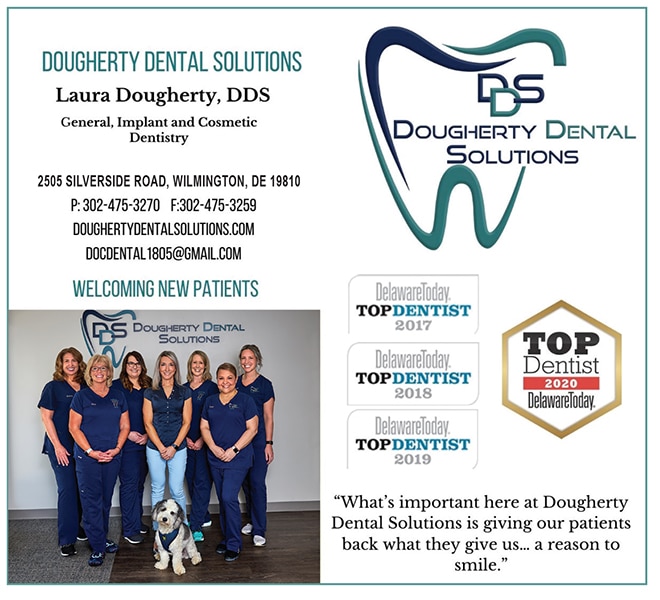
Born and raised in Delaware’s Sussex County, “Dr. D” earned a B.A. degree in Biology from the University of Delaware in 2001 before going on to study dentistry at the University of Maryland’s Baltimore College of Dental Surgery, achieving her Doctorate of Dental Surgery degree in 2006. After completing her General Practice Residency with the Christiana Care Dental Residency Program, she went into private practice for 11 years prior to opening Dougherty Dental Solutions in 2018. Dr. Dougherty has been named Top Dentist in Delaware Today for three years in a row, taking pride in restoring and maintaining her patients’ smiles.
Testimonials
“Amazing Dr.! She took her time explaining everything in detail. Also her staff was AMAZING. If you are looking for an amazing Dentist, this is the place to be. I had 2 crowns to get done. She was so particular to get a good foundation. Also the temporary feels better than my original crown that I had done at a different dentist. Thanks a million Dr. Dougherty.” ~ SS
“Love it here. For the first time in years, I don’t dread going to the dentist. Dr Dougherty and staff are caring, thorough and very professional. I highly recommend them if you are looking for an outstanding dentist.” ~ JD
“My first visit to the dentist was very positive. The staff was excellent and friendly, the process was easy, and the care was second-to-none. The office pooch, Cooper, made it even better! I would recommend them to anyone.” ~ SM
Dougherty Dental Solutions
2505 Silverside Road, Wilmington, DE
302-475-3270
www.DoughertyDentalSolutions.com
Follow them @doughertydental_1805 on instagram and @DoughertyDentalSolutions on facebook