
By Paula Ko, MD
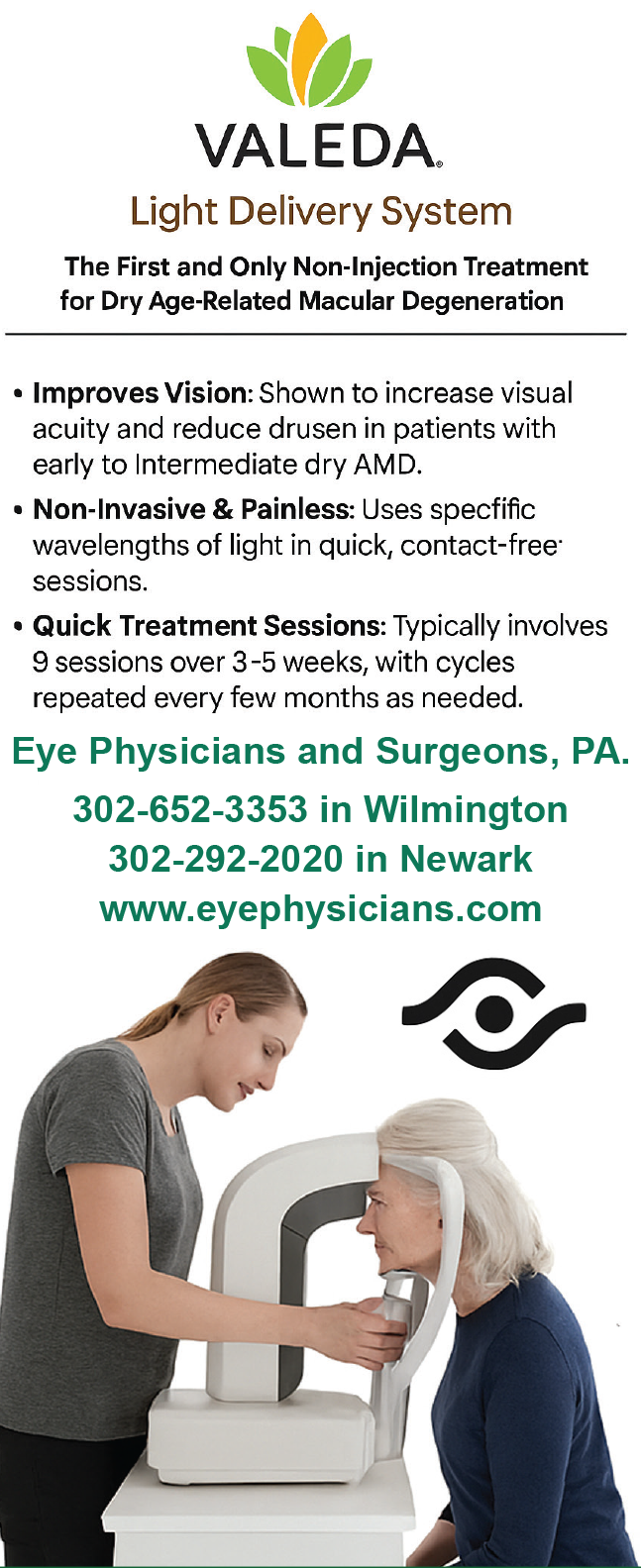
If you or someone you love has been diagnosed with dry age-related macular degeneration (AMD), you’re probably familiar with a frustrating message from your eye doctor: “There’s nothing more we can do – we’ll just keep monitoring it.” For decades, that has been the reality for millions of patients with this common condition. But that reality is finally changing, thanks to an exciting new treatment called photobiomodulation (PBM) and we’re proud to say it’s now available right here in Delaware, exclusively at our practice.
What is dry AMD, and why does it matter?
Age-related macular degeneration affects the macula, the small central part of the retina responsible for sharp, detailed vision — the vision you use for reading, recognizing faces, and driving. The “dry” form of AMD, which accounts for the vast majority of cases, occurs gradually as the light-sensitive cells in the macula break down over time. Left unaddressed, it can slowly rob patients of their central vision, making everyday tasks increasingly difficult. Until recently, there were no approved treatments that could meaningfully change that trajectory.
How does photobiomodulation work?
Photobiomodulation therapy uses specific, carefully calibrated wavelengths of low-level yellow, red and near-infrared light, delivered painlessly and non-invasively to the back of the eye during a quick in-office session. The science behind it centers on the mitochondria — the tiny structures inside our cells often called the “powerhouses” of the cell because they generate the energy cells need to function.
As we age, mitochondria throughout the body, including in the delicate cells of the retina, naturally become less efficient at producing energy. In the eye, this energy decline is believed to be one of the underlying contributors to the cellular stress and damage seen in dry AMD. PBM works by stimulating these mitochondria, essentially giving retinal cells a boost in energy production. This, in turn, may help reduce inflammation, support cellular repair processes, and improve the overall health and function of the retina. The result for many patients is not just a slowing of vision loss, but in many cases, a genuine improvement in vision.
Who is the best candidate for this treatment?
PBM therapy tends to work best for patients in the early to intermediate stages of dry AMD as well as patients with geographic atrophy outside of the macula, before extensive, irreversible damage to the central vision has occurred. Patients who still have functioning retinal tissue that can respond to the light stimulation tend to see the most benefit. The best way to find out if you’re a candidate is through a comprehensive eye exam and OCT retinal imaging, which your ophthalmologist can use to evaluate the specific stage of your AMD.
What kind of results can patients expect?
The results from clinical research have been genuinely exciting. In studies of this therapy, an impressive 83% of patients treated with PBM improved by at least one line on a standard vision chart, and some improved by two lines or more over a 21-month treatment period. For a disease that has historically only progressed in one direction, this kind of measurable improvement represents a real breakthrough, and it’s the reason so many of our patients have described this treatment as life-changing.
Why choose our practice?
We are proud to be the only practice in the state of Delaware currently equipped with this advanced technology. Our patients have expressed genuine relief and excitement at finally having a proactive treatment option, rather than simply watching their vision decline year after year. Many describe a renewed sense of hope after years of feeling like their hands were tied.
If you or a family member has been diagnosed with dry AMD, we encourage you to ask us whether photobiomodulation therapy might be right for you. The earlier this treatment begins, the greater the potential to protect and maybe even improve your vision for years to come. Please call 302-652-3353 or visit www.eyephysicians.com.
Bio
Dr. Ko is currently managing partner at Eye Physicians and Surgeons, P.A. and has practiced there for over 30 years. She is a Clinical Assistant Professor of Ophthalmology at Temple University Hospital and has enjoyed training the Temple Residents retinal surgery and disease management. She enjoys teaching her patients about their disease process and what they can do systemically to help their eye disease improve. She believes in good communication between the doctor and patient for the best care possible. She uses the latest technology, small incision surgery, laser, and intraocular injections to help treat patients with retinal diseases.
Dr. Ko also serves as the President of the Delaware Academy of Ophthalmology, helping promote excellent eye care throughout the entire state of Delaware. She has offices in Wilmington, Newark, and Dover.
Eye Physicians & Surgeons, P.A. 1207 North Scott Street, Wilmington, Delaware 302-652-3353 eyephysicians.com
follow us on facebook & instagram